Glucagon-like peptide-1 receptor (GLP-1R)/glucose-dependent insulinotropic peptide receptor (GIPR) agonistic analogs have yielded superior results in enhancing glycemic control and weight management compared to GLP-1R agonism alone. Intriguingly, GIPR agonism appears to induce antiemetic effects, potentially alleviating part of the nausea and vomiting side effects common to GLP-1R agonists like semaglutide. Here, we show in rats and shrews that GIPR agonism blocks emesis and attenuates other malaise behaviors elicited by GLP-1R activation while maintaining reduced food intake and body weight loss and improved glucose tolerance. The GLP-1R/GIPR agonist tirzepatide induced significantly fewer side effects than equipotent doses of semaglutide. These findings underscore the therapeutic potential of combined pharmaceutical strategies activating both incretin systems, leading to enhanced therapeutic index and reduced occurrence of nausea and vomiting for obesity and diabetes treatments. Publication link
Tirzepatide induces less kaolin consumption in rats compared to equipotent doses of semaglutide.
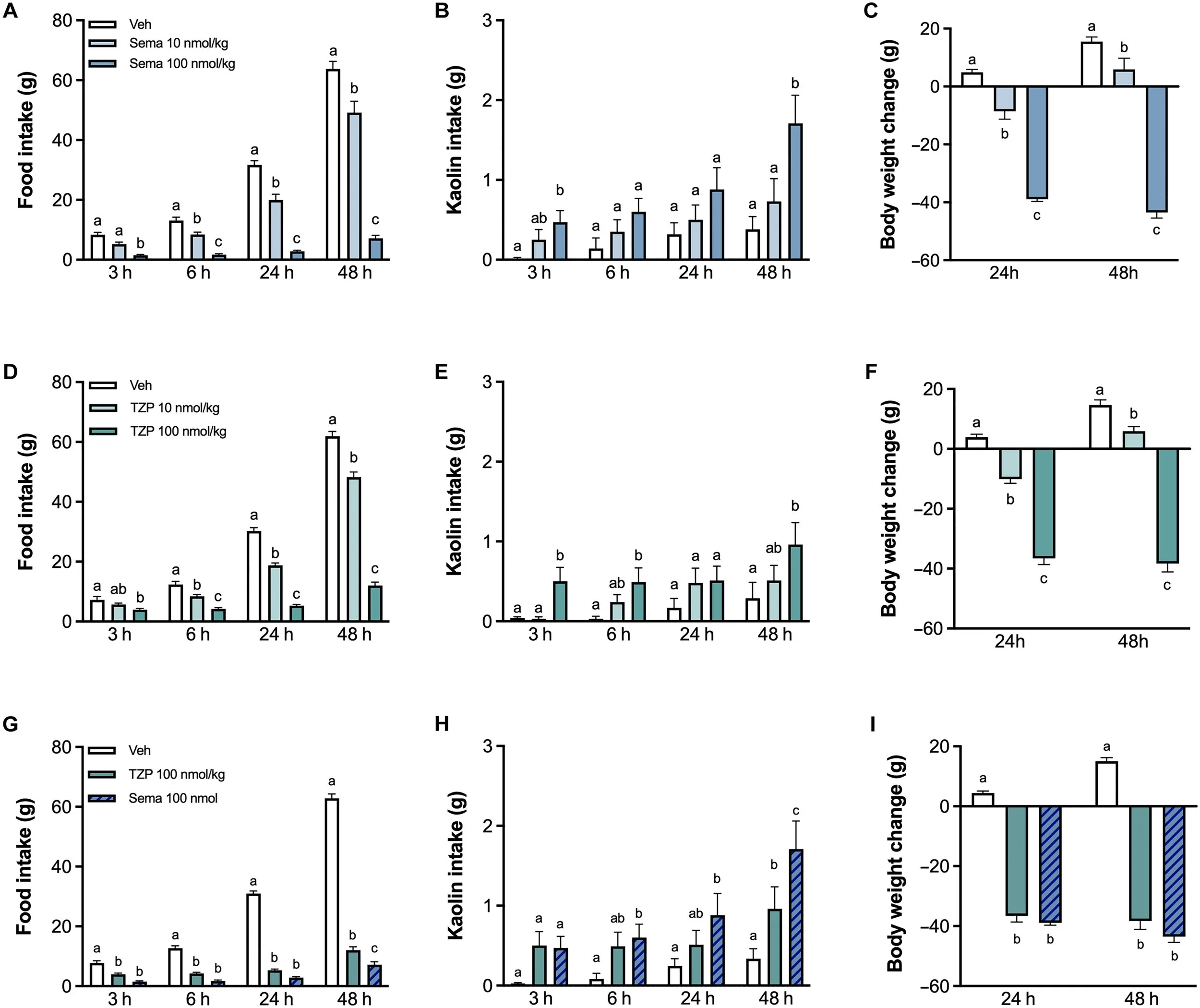
(A) Semaglutide administration dose-dependently suppresses food intake in rats (10 and 100 nmol/kg, ip; n = 10 per group). (B) The highest tested dose of semaglutide causes significant malaise (i.e., kaolin intake) in rats (100 nmol/kg, ip; n = 10 per group). (C) Semaglutide administration causes body weight loss in a dose-dependent manner (10 and 100 nmol/kg, ip; n = 10 per group). (D) Tirzepatide (TZP) dose-dependently suppress food intake (10 and 100 nmol/kg, ip; n = 10 per group). (E) Systemic administration of tirzepatide (100 nmol/kg) causes significant kaolin intake (ip, n = 10 per group). (F) Tirzepatide dose-dependently suppresses body weight (10 and 100 nmol/kg, ip; n = 10). (G) Tirzepatide and semaglutide induce comparable hypophagic responses in rats compared to controls (100 nmol/kg, ip; n = 10 to 20 per group). (H) Semaglutide administration induces higher kaolin consumption than tirzepatide treatment (100 nmol/kg, ip; n = 10 to 20 per group). (I) Tirzepatide and semaglutide cause similar body weight loss (100 nmol/kg, ip; n = 10 to 20 per group). All data expressed as means ± SEM. Data in (A) to (F) were analyzed with repeated measures two-way ANOVA followed by Tukey’s post hoc tests. Data in (G) to (I) were analyzed with repeated measures mixed-effects model followed by Tukey’s post hoc tests. Means with different letters are significantly different from each other (P < 0.05).