The locus coeruleus calcitonin receptor can be engaged by amylin and calcitonin gene-related peptide to suppress feeding without inducing nausea
Efforts to fully characterize the diversity of mechanisms underlying energy balance control have led to the identification of atypical sites of action for metabolic signals. The locus coeruleus (LC), a major noradrenergic nucleus of the brain, has recently been shown to regulate aspects of food intake and energy expenditure. We use complementary pharmacological, behavioral, immunohistochemical, and genetic approaches in both rats and mice to demonstrate the role of LC calcitonin receptors (CTR) in feeding behavior. LC neurons robustly express CTRs that can be pharmacologically and chemogenetically activated to potently inhibit food intake and body weight without inducing nausea or changes in autonomic physiology including heart rate, body temperature, and gastric emptying. We next examined the ability of amylin and calcitonin gene-related peptide (CGRP), two endogenous anorectic peptides that signal through the CTR, to modulate feeding through signaling in the LC. RNAscope analysis revealed that LC CTRs are in fact capable of responding to amylin and CGRP, as they co-express RAMP1, and microinjections of either peptide to the LC induces anorexia without nausea. Together, these findings identify LC CTRs as a previously unrecognized neural substrate through which amylin and CGRP signaling suppress feeding, with direct relevance to the mechanisms underlying emerging amylin-based obesity therapeutics.
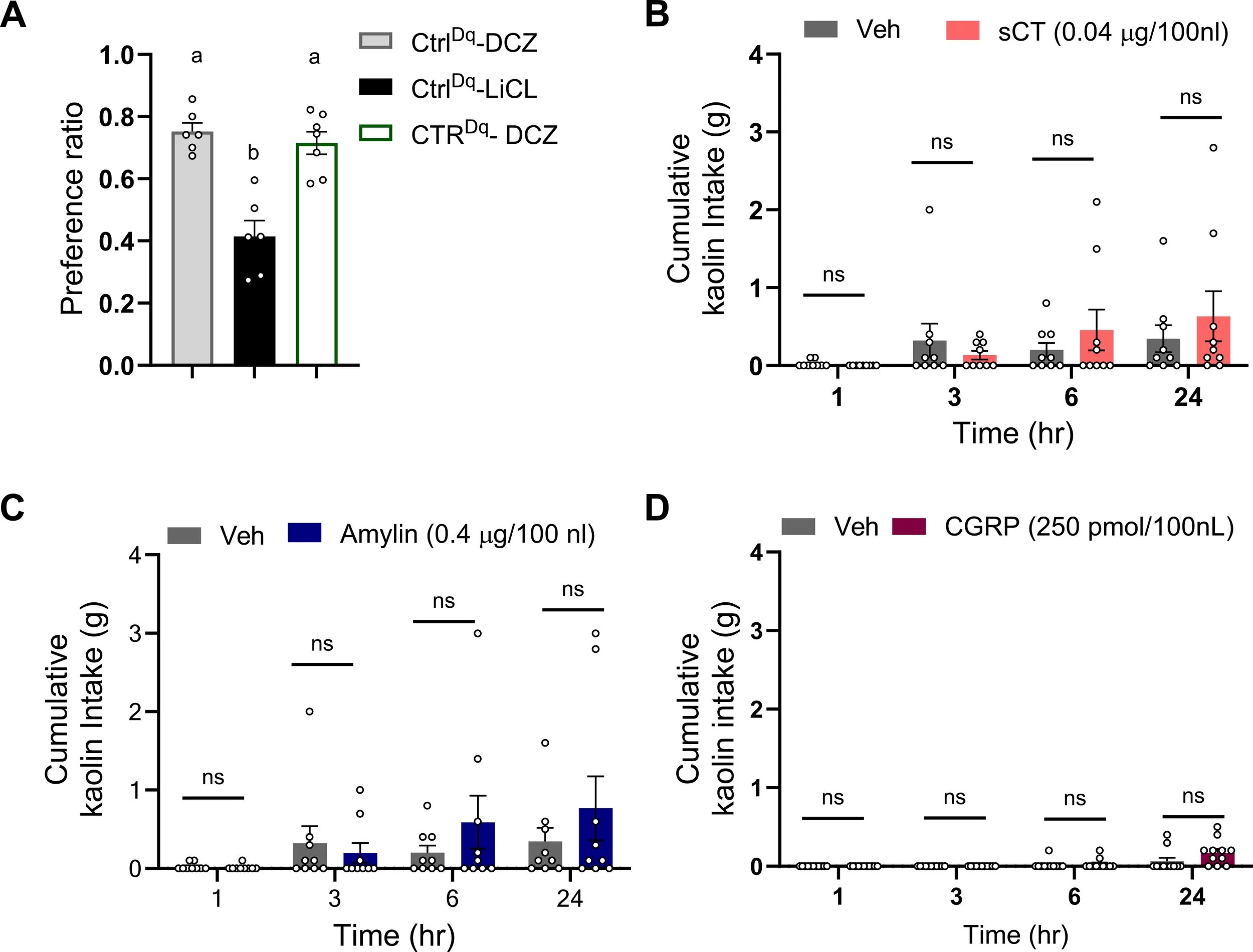
Feeding suppression by LC CTR neuron activation and calcitonin-family peptides and is not associated with nausea-related behavior.
(A) Conditioned flavor preference in mouse. Preference ratio measured following pairing of flavored solutions with deschloroclozapine (DCZ) in control Dq-expressing mice (Ctrl Dq, n = 6) and calcitonin receptor–expressing LC Dq-expressing mice (CTR Dq, n = 6), or lithium chloride (LiCl) in control mice (n = 6). A one-way between-subjects ANOVA revealed a significant effect of treatment, with post hoc comparisons indicating reduced preference following LiCl but not following DCZ for either genotype. (B) In rat, cumulative kaolin intake measured over 1, 3, 6, and 24 h following administration of vehicle or salmon calcitonin (sCT; 0.04 μg/100 nl). No differences in kaolin intake were observed between vehicle- and sCT-treated conditions at any timepoint. (C) In rat, cumulative kaolin intake measured following vehicle or amylin (0.4 μg/100 nl). Amylin did not alter kaolin intake relative to vehicle at any timepoint examined. (D) In rat, cumulative kaolin intake measured following vehicle or CGRP (250 pmol/100 nl). CGRP did not alter kaolin intake relative to vehicle at any timepoint. For B-D, within-subject comparisons between vehicle and peptide conditions were performed using paired t tests at each timepoint ( n = 9). All data are presented as mean ± SEM with individual subjects shown. Groups not sharing a common letter differ significantly ( p < 0.05).